
 I’m a fan of making life as simple as possible in the kitchen. While making marmalade is bound to be time consuming and a tad complicated, the payoff is rich. You end up with a whole whack of jars to use throughout the year. And, if you’ve got homemade preserves around, you’re almost always good to go in a gift-mergency.
The “whole fruit” method I use here is perhaps the easiest way to get from point A to point Z. You set the whole oranges at a slow boil for over an hour. This way, when it comes time to slice the rinds, etcetera, you have a soft peel to work with. [I’m a fan of whole-roasting squash, too. So, the whole-fruit method is a no-brainer for me!] The marmalade I make, resultantly, is a tad more bitter and pithy than marmalade made by prepping fruit cold. It’s also chunkier, too, because, since I broke my hand a couple of years ago, I’m not as fussy with my knife. Tastes great to me.
 Equipment notes: You’re best off working with a food scale and a candy thermometer here. I only got a food scale a couple of years ago, when I started learning how to make pastries and marmaldes. And, I have to say, it’s changed the way I cook everything. No worries about spending a fortune, either. I got my food scale for under $15. Just make sure you get one with a “tare” button so you can subtract the weight of your bowls and measuring cups. Though, at this point, I think it would be difficult to find a scale without one.
And, let’s talk temperature: The official “set point” for marmalade is 220°F. However, depending on the temperature outside or in your kitchen and the shape and “character” of your cooking vessel, things can change dramatically with each batch. Once, recently, I boiled to 220°F and, after waiting a few days to see how my marmalade set up, the entire batch was runny. No fear. I simply emptied the cans back into the pot, reheated to 224°F and re-canned. In general, I prefer a thicker marmalade, so I tend to cook until the mix is fairly hot and firm, in the 222-223°F range. As much as I like citrus “sauce” or “syrup,” I’d rather thin a too-thick marmalade as needed, by the jar, with hot water or a quick visit to the stove. An extra way to tell if marmalade has set it to place a plate in the freezer before you start cooking, place a spoonful of the boiled marmalade on the plate, and set it back in the freezer for a few minutes to see if it “ruffles” or “wrinkles” when you push the edges with your finger.
So, set an afternoon aside for this, loves. Invite a neighbour to join and make “duelling” batches on the stove. Put on a fave movie while you’re preparing your peel. Enjoy the high-class steam facial that comes along with water-bath canning. And, reap the rewards all year long.
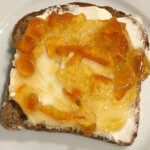
Chunky, Bitter, Pithy, Seville Orange Marmalade [Whole Fruit Method]
Ingredients
- Seville Oranges* [8-10 large sevilles about 1.5-2Kg, or 3.5-4.5 lbs. No need to be exact]
- Water
- Juice of 3 medium lemons [about 1/3 cup]
- Sugar [one 2 kg bag]
Instructions
- Place the oranges into a large, heavy-bottomed pot.
- Cover the oranges in water. [If they bob up a lot, you might choose to weigh them down with a plate.]
- Cover the pot and bring the water to a boil.
- Then, simmer on medium-low heat for 90* minutes, until fork-tender.
- Place a large bowl on a food scale and set to tare.
- Reserving the cooking water, carefully move the fruit to the bowl and weigh it, keeping track of the measurment. [Mine was 2 kg.]
- Remove the bowl of oranges from the scale.
- Place a clean, empty bowl on the scale and set to tare.
- Fill the bowl with the lemon juice.
- Then, add enough of the cooking water to equal the weight of the oranges after boiling. [Mine was 2kg]. If you don’t have enough, use water from a tea-kettle.
- Measure and set aside an equal amount of sugar. [I used a 2kg bag.]
- Get out a rimmed cutting board or place a cutting board inside of a big tray or baking sheet.
- Get two bowls out, one large one for collecting the juice and insides of the oranges, one small one for collecting the seeds.
- Over the large bowl, halve the oranges so that most of the juice escapes into the bowl.
- Then, scoop the insides of each orange half.
- Place the pulp into the large bowl with the juice. But, remove and sort the seeds into the smaller bowl.
- Thin-slice or dice the peel.
- Pour any juice from the cutting board into the juice-and-pulp bowl.
- Discard the seeds.
- Place the following back into a wide, heavy-bottomed pot or saucepan: the juice and pulp from the oranges, the sliced or diced peel, the reserved measured lemon juice and cooking water, the measured sugar.
- Attach a candy thermometer to the pot.
- Bring the marmalade to a boil, uncovered, and cook briskly, stirring frequently, until the mixture thickens, darkens, and reaches a minimum of 220°F and no more than 224°F.** [This may take 20-30 minutes, this may take 90 minutes. It all depends upon the day, the weather, your ingredients and how thick you like your marmalade.]
- Remove the pan from the heat.
- With a spoon, skim off any bubbles, scum, or wayward seeds.
- Ladle the marmalade into hot, sterilized jars, leaving about 1/4 inch headspace. Of course, I like to keep a small bowl of marmalade out to the side to sample as soon as it cools.
- Seal the jars and process in a hot water bath for 7-10 minutes. Allow jars to cool for at least 24 hours. It sometimes takes 2-5 days for marmalade to set. If, after that time, the mixture is not as thick as you’d like, re-boil 1-2 degrees above the previous temperature and re-jar.


Leave a Reply